
To buy a phone number for business, pick the type that fits your customers (local, toll-free, vanity, or VoIP), choose a seller that lets you port the number later, pay for it, and connect it to a line that rings on your phone. A standard number from a VoIP provider takes minutes and starts around $10 a month. A premium patterned number from a marketplace is a one-time purchase, from $249 at Numoreé, and usually takes 4 to 10 business days to transfer to your carrier.
The problem is that the market looks like one product but is really three. Free calling apps hand you a random number. VoIP providers sell a number bundled with a monthly plan. Marketplaces sell a specific, memorable number and nothing else. If you do not know which one you are buying, you can pay twice, get stuck with a number you cannot move, or end up with a number that rings nowhere.
This guide walks you through the purchase in four steps: choose the type and area code, choose where to buy, complete the purchase and transfer, and set the number up so it works. We run Numoreé, a marketplace for premium local and toll-free numbers, so we see what goes right and wrong when people buy a business phone number, and we point out both.
What you are buying before you start
A business phone number is a dedicated number that callers dial to reach your company, separate from your personal cell. You can buy a business phone number from a carrier, a VoIP provider, or a marketplace, and it can ring on the phone you already own.
Why a separate number is worth buying
When you give out your personal cell, clients call at all hours, you cannot route or screen calls, and your private number ends up on websites, invoices and ad listings. A dedicated number fixes that. You can set business hours and voicemail greetings, forward calls to a teammate, and turn the line off without silencing your family.
A business number also signals that a real company is behind the website. That matters most for local service businesses, where a stranger decides in seconds whether to call you.
A number and a phone line are two purchases
The number is the identifier customers dial. The line is the carrier, VoIP service or app that makes it ring. Free apps and VoIP plans bundle both, so you never notice the split. A marketplace sells only the number, and you then move it to a provider you already pay. Keep this in mind through every step below.
The number is what customers dial. The service is what makes it ring.
The four types at a glance
The table compares the main options. "Virtual" or "VoIP" describes how calls are delivered over the internet, not a different number format. A local, toll-free or vanity number can all run on VoIP.
Type | What it looks like | Typical cost | Best for
Local | A regional area code, such as 201 | Often included in a VoIP plan. Premium patterns are a one-time purchase | Businesses serving a city or region
Toll-free | Prefixes 800, 833, 844, 855, 866, 877, 888 | Usually a monthly fee or part of a plan | National or online businesses
Vanity | Repeated digits or a word, like 1-800-FLOWERS | One-time price for premium numbers, plus service fees | Advertising, signage, vehicles
Virtual/VoIP | Any of the above, delivered over the internet | Free personal apps to about $10 a month for basic plans, $20 to $30+ for full systems | Solo owners and remote teams
Step 1. Choose your number type and area code
Choose the type by asking who calls you and how they find you. Local customers trust a local area code, national customers expect toll-free, and anyone who sees your number on a truck or sign benefits from a pattern they can remember.
Match the type to the people who call you
Use these rules as a starting point:
- Customers in one city or county: a local number in their area code.
- Customers across the country or online: a toll-free number.
- Heavy advertising, signage or radio: a vanity number, local or toll-free.
- A remote team or a solo owner on a phone: any of the above delivered through a VoIP app.
You can mix them. Many businesses run a local number for marketing in their home market and a toll-free number on the website.
Choose an area code that matches your customers
Pick the area code your customers recognize, not necessarily the one you live in. A contractor in Jersey City who serves northern New Jersey gains more trust from a 201 number than from a distant code. Providers let you search by area code, city or state, so check what is actually available before you commit to a plan.
Pick the area code your customers live in, not the one you do.
Decide what a memorable pattern is worth
A standard number is assigned from a provider's pool, so you get whatever is free. A premium number is chosen on purpose, such as four repeated digits at the end. Price depends on the pattern and the whole number. These Numoreé listings show the spread for one area code:
Number | Location | Price
201-267-2222 | Oradell, NJ | $249
201-335-4444 | Rochelle Park, NJ | $349
201-426-6666 | Little Ferry, NJ | $449
201-298-0000 | Hasbrouck Heights, NJ | $995
201-201-4444 | Jersey City, NJ | $1,995
Pay for a pattern when your number will appear in ads, on vehicles or on a sign. Skip it if customers will mostly reach you through a website button or a search listing.
Step 2. Choose where to buy your number
You can buy a business phone number from a VoIP provider, a free calling app, or a premium marketplace. The right source depends on whether you want any number that works or one specific number you will keep for years.
The three places to buy
Source | What you get | Cost pattern | Watch out for
VoIP provider | An assigned number plus calling features | Monthly, from about $10 for basic plans | Pool of numbers is random, so patterns are rare
Free app | A free number, such as a Google Voice personal number | Free, with limited business features | Numbers can be reclaimed after inactivity, and Google Voice offers its free numbers only on personal accounts
Marketplace | A specific, memorable number, local or toll-free | One-time price, then your carrier's service fee | You must bring your own carrier or VoIP service
Free is a fair way to test the idea. If customers will ever see the number on printed material, move to something you control.
Check porting and ownership before you pay
Ask one question before any purchase: can I port this number out later? If the provider controls the number, a future switch means a new number and a reprint of every card and sign. Ask for the porting policy in writing, and confirm there is no fee to leave. With a marketplace, the number becomes part of your telecommunications account once the transfer completes, subject to carrier rules.
A number you cannot take with you is a rental, not an asset.
Compare the first-year cost
Here is a worked example. The service figures are illustrative, so check your own provider's price.
Setup | Number cost | Service cost | First-year total
Assigned number on a basic $10-a-month plan | $0 | $120 | $120
201-426-6666 on the same $10 plan | $449 | $120 | $569
201-426-6666 on a $20-a-month VoIP system | $449 | $240 | $689
The premium number adds a one-time $449. In year two, both setups cost only the monthly service again. That is why a pattern costs less over time than it first appears.
Step 3. Buy the number and connect it
Buying a standard number takes minutes because the provider assigns it to your account. Buying a premium number is a purchase followed by a transfer, which takes longer but ends with the same result: the number lives in your account.
Buy from a VoIP provider
Follow these steps:
- Create an account with your business name and contact details.
- Search by area code, city or toll-free prefix.
- Pick a number and a plan.
- Pay and confirm the number appears in your dashboard.
- Install the provider's app on your phone and computer.
Buy a premium number and port it
With a marketplace, you pay first and then move the number. After checkout, Numoreé emails the account number, transfer PIN, service address and porting instructions your carrier needs. You give those details to your carrier or VoIP provider, which brings the number into your account. We begin the process once payment is received, and most transfers complete within 4 to 10 business days, depending on the carrier and number type.
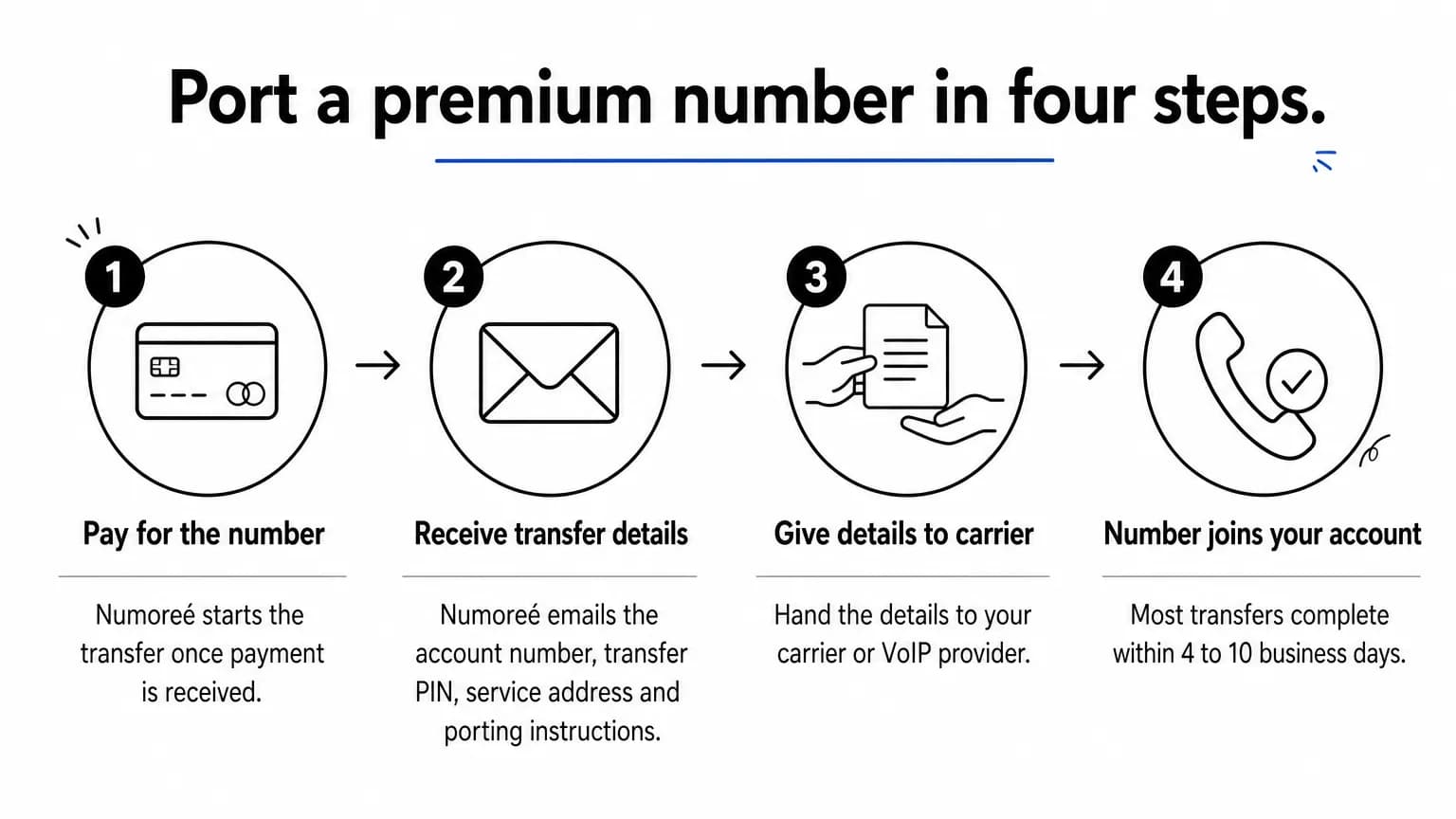
Set up your receiving account before you buy, and confirm it accepts ported numbers of that type. The price is a one-time cost for the number. Your carrier may charge separate monthly fees. We generally do not offer refunds once a transfer has begun, so double-check the digits before you pay.
Open your receiving account first, then buy the number, so the transfer has somewhere to land.
Is it legal to buy a number, and what about your EIN?
Yes. Acquiring a number through a carrier, a provider or a marketplace and porting it to your service is a normal practice, and the number stays subject to carrier regulations. The EIN question comes up at the carrier, not at the number. Many carriers accept an EIN to open a business account, but requirements differ, so ask what documents they want before you buy. If you only want the number and no new service, you still need somewhere for it to ring, so any "just the number" purchase ends with a port to a provider.
Step 4. Set up your number and start using it
Setup means routing calls to a phone, recording a greeting, and putting the number everywhere customers look. Do it in that order so the first real call does not go to a dead line.
Route calls and record a greeting
Start with these settings:
- Forward calls to your mobile or a teammate's phone.
- Set business hours so after-hours calls go to voicemail.
- Turn on voicemail-to-email or transcription if your plan offers it.
- Record a greeting in your own voice.
Keep the greeting short and say the business name first. Here is a script you can copy:
<code>Thanks for calling [Business Name]. We can't take your call right now.
Please leave your name, number, and a short message, and we'll call you
back by the end of the next business day. If it's urgent, text this
number and we'll respond as soon as we can.
</code>
Test before you publish
Call the number from a phone that is not yours. Check that it rings, that the greeting plays, and that voicemail arrives. Test once during business hours and once after. If you plan to text customers from the number, ask your provider about registration, because US carriers require business texting to be registered or verified.
Put the number where customers look
Update your website header and contact page, your Google Business Profile, email signatures, invoices, social profiles and any directory listing. Use the same format everywhere, such as 201-426-6666, because mismatched listings confuse both customers and search engines. Then add it to printed material.
A number only builds trust once every place customers look shows the same one.
Get your number working this week
Buying a business phone number comes down to four decisions. Choose the type and area code that match your customers. Pick a source that lets you port the number out. Complete the purchase and the transfer. Then route, test and publish it. Treat the number and the service as two separate costs, and a premium pattern becomes a one-time expense instead of a recurring one.
If you want a memorable local or toll-free number, you can search Numoreé for premium vanity numbers by area code, city, state or keyword, buy one at a fixed price, and use the steps above to move it to your carrier. If the number you want is not listed, our team can look for it.